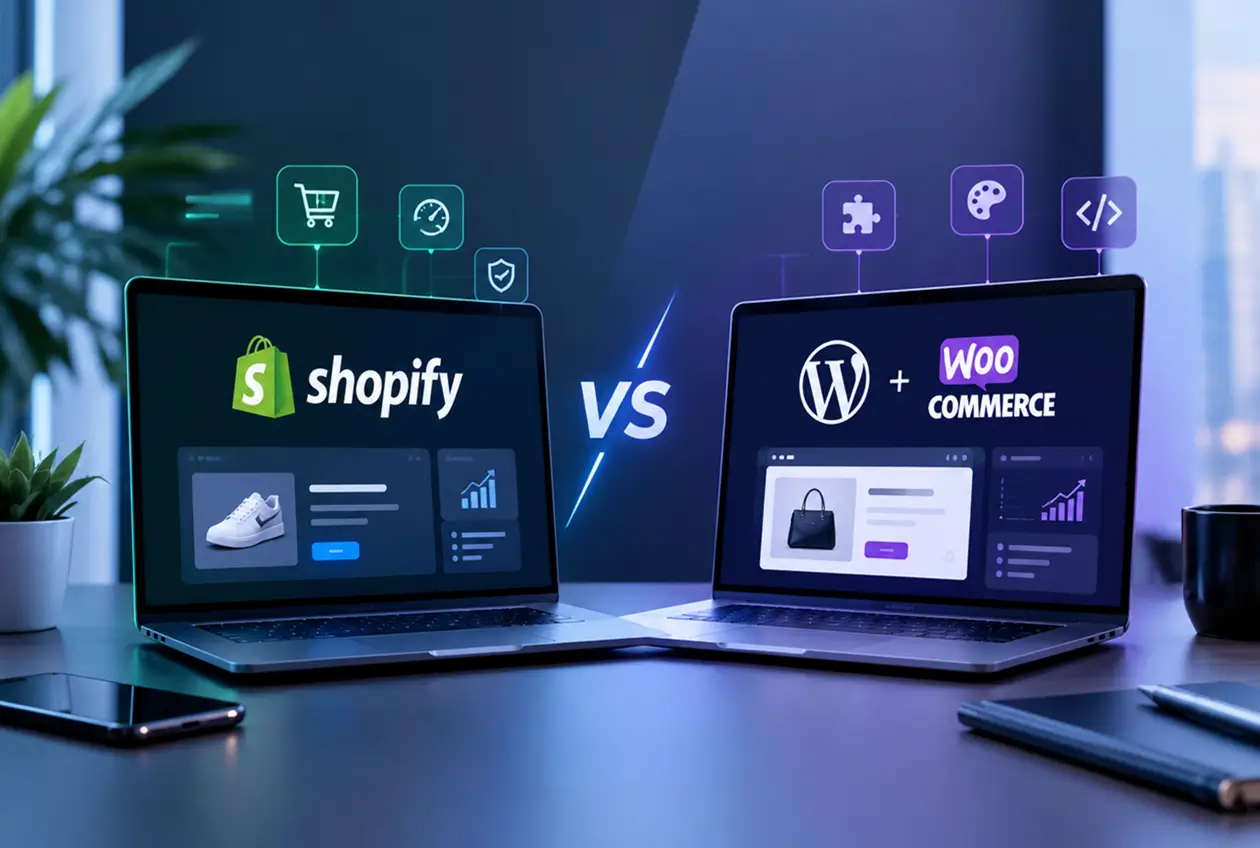
Ask five web developers “Shopify vs WordPress” and you’ll get five confident, contradictory answers usually shaped by whichever platform that developer happens to build in. Here’s a version without a thumb on the scale: both are genuinely good platforms, i use both regurarly, and the right one depends on specifics most generic comparisons skip entirely.
Start With This Question, Not the Feature List
Before comparing checkout flows or app marketplaces, answer one thing: do you want to manage the technical side of your store, or hand it off entirely?
If the honest answer is “hand it off,” that alone points toward Shopify — hosting, security, and platform updates are handled for you. If the answer is “I want full control, even if it means more responsibility,” that points toward WordPress with WooCommerce. Nearly every other difference between the two platforms flows from this one tradeoff.
Shopify
What you get: a fully managed platform — hosting, security patches, and updates happen automatically, and the checkout experience is polished out of the box. Launch timelines are typically faster since there’s less infrastructure to configure.
What it costs you: less flexibility for highly custom functionality without paying for additional apps or developer work, ongoing transaction fees unless you use Shopify’s own payment processor, and you’re ultimately building on a platform whose pricing and policies you don’t control.
Best fit: a standard product catalog, a business that wants to launch quickly, and an owner who has no interest in managing technical infrastructure.
WordPress + WooCommerce
What you get: complete control over functionality, design, and hosting, no mandatory percentage-of-sales fee built into the platform, and the ability to build genuinely custom functionality through plugins or direct development.
What it costs you: you (or someone you hire) become responsible for hosting, security, and updates — which is exactly why a WordPress security checklist matters more here than it would on a managed platform. Reaching Shopify’s out-of-the-box polish also takes more deliberate setup.
Best fit: a business needing custom functionality, one planning to scale into complexity a hosted platform makes expensive to support, or anyone who wants to own their stack outright.
Shopify vs WordPress On Cost, Specifically
Shopify’s pricing is easy to state upfront: a predictable monthly plan plus transaction fees. WordPress and WooCommerce costs vary more since hosting, plugins, and development are separate line items — but there’s no baked-in percentage-of-sales fee. If you want the fuller cost breakdown for the WordPress side, see how much a professional WordPress website costs.
Neither is categorically cheaper. A simple Shopify store can cost less than a heavily customized WooCommerce build; a simple WooCommerce site can cost less than a Shopify store loaded with paid apps. The comparison only makes sense once you know your actual complexity.
A Question I Get Often
“Can I just start on Shopify and move to WordPress later if I outgrow it?”
Yes, and it’s a reasonable path for a business unsure of its long-term complexity. Migration is real work product data, SEO redirects, and design all need careful handling to avoid losing existing rankings but starting simple and migrating once you have actual traction is often smarter than over-building a complex WordPress setup for a store that doesn’t need it yet.
Where I’ve Seen This Play Out
Monica Marracino’s fashion brand site, monicamarracino.com, is a good example of where Shopify is the right call. The brand needed a clean, custom-minimal design that fit its identity, without any of the custom backend work a platform like WooCommerce would require. We took advantage of Shopify’s built-in structure the product catalog, inventory management, checkout, server and security are all handled by the platform itself and had the store fully designed, populated with products, and ready to launch in 7-10 days. Payments and automated order emails were integrated directly on top of Shopify’s existing setup with no custom build needed, which meant the brand could move straight into email marketing almost immediately after launch instead of waiting on development work.
waltersteiger.it is the opposite case. The client sells custom-modeled women’s shoes and wanted a fully personalized product builder, not a standard product page. A visitor can choose the shoe’s silhouette (dark or natural), pick from 40 material colors and 25 different materials, select a size, add a silver or gold tag to the sole, personalize that tag with their own note of max 25 char, and view the shoe from multiple angles before purchasing, all before adding it to cart. Nothing about that configuration flow exists as a standard feature on either platform, but building it required the kind of open-ended control WooCommerce allows and Shopify’s more rigid product structure doesn’t. This is the clearest version of the “custom vs. managed” tradeoff in practice: Shopify couldn’t have built this without extensive app workarounds, while WooCommerce made it possible to build exactly what the brand needed.
Bottom Line
Put simply: WordPress with WooCommerce tends to win on price, since the software itself is free, and it wins outright on freedom, if you need something custom or want unlimited room to integrate and expand, or even a ready-made template, it gives you the flexibility to build exactly what you want, as the Walter Steiger example shows. The tradeoff is that it takes more work and more ongoing management. Shopify costs more and gives you less room to go outside the box, but it’s self-managed and gives you back your time, the better choice if you want simplicity and an all-in-one platform rather than full control. The right answer isn’t which platform is objectively better; it’s which tradeoff your business is actually willing to make.
FAQ
Is Shopify or WordPress better for SEO?
Both can perform well with proper setup. WordPress offers more granular technical SEO control, while Shopify has improved significantly in this area and handles much of the technical foundation automatically.
Which platform is cheaper long-term?
It depends on scale and complexity, as covered above — Shopify’s costs are predictable but include ongoing transaction fees; WordPress avoids mandatory transaction fees but costs vary more with hosting and development needs.
Do I need a developer for either platform?
Shopify is more approachable without a developer for standard stores. WordPress with WooCommerce generally benefits from developer involvement, especially for custom functionality or ongoing maintenance.
Is WooCommerce a plugin or a separate platform?
WooCommerce is a free plugin that turns a WordPress site into a fully functional online store, it isn’t a separate platform, which is why “WordPress vs Shopify” and “WooCommerce vs Shopify” are effectively the same comparison.