Choosing the right platform is one of the most important decisions you’ll make when building a website or launching an online store.
Two names dominate the conversation: WordPress and Shopify.
Both platforms are powerful, widely adopted, and capable of supporting successful businesses. However, they are designed with different goals in mind, and choosing the wrong platform can create unnecessary limitations, costs, and technical challenges down the road.
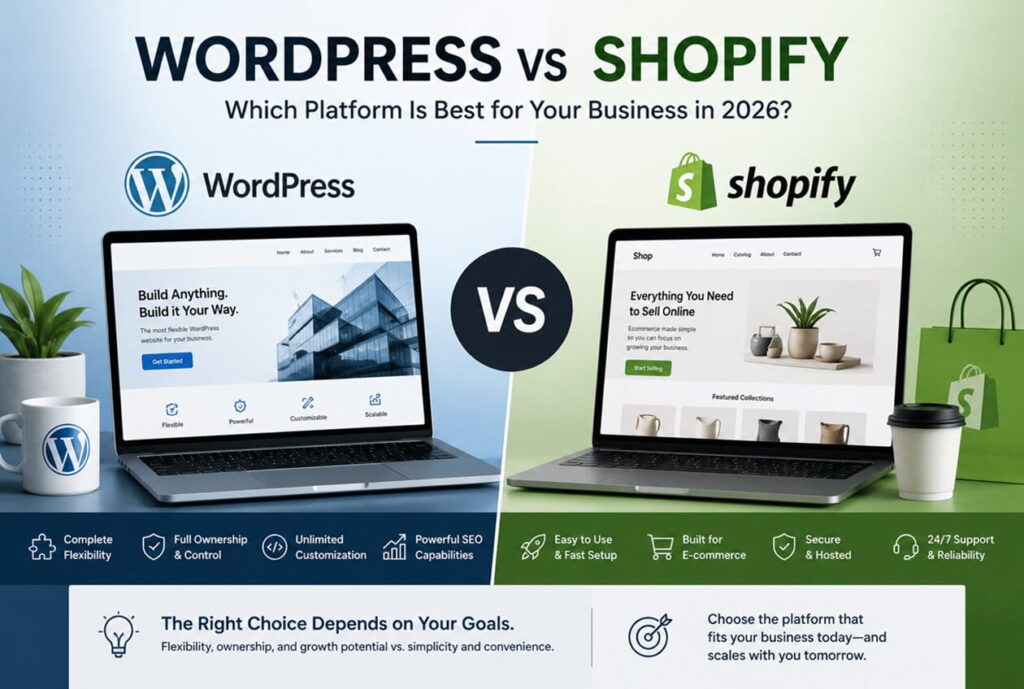
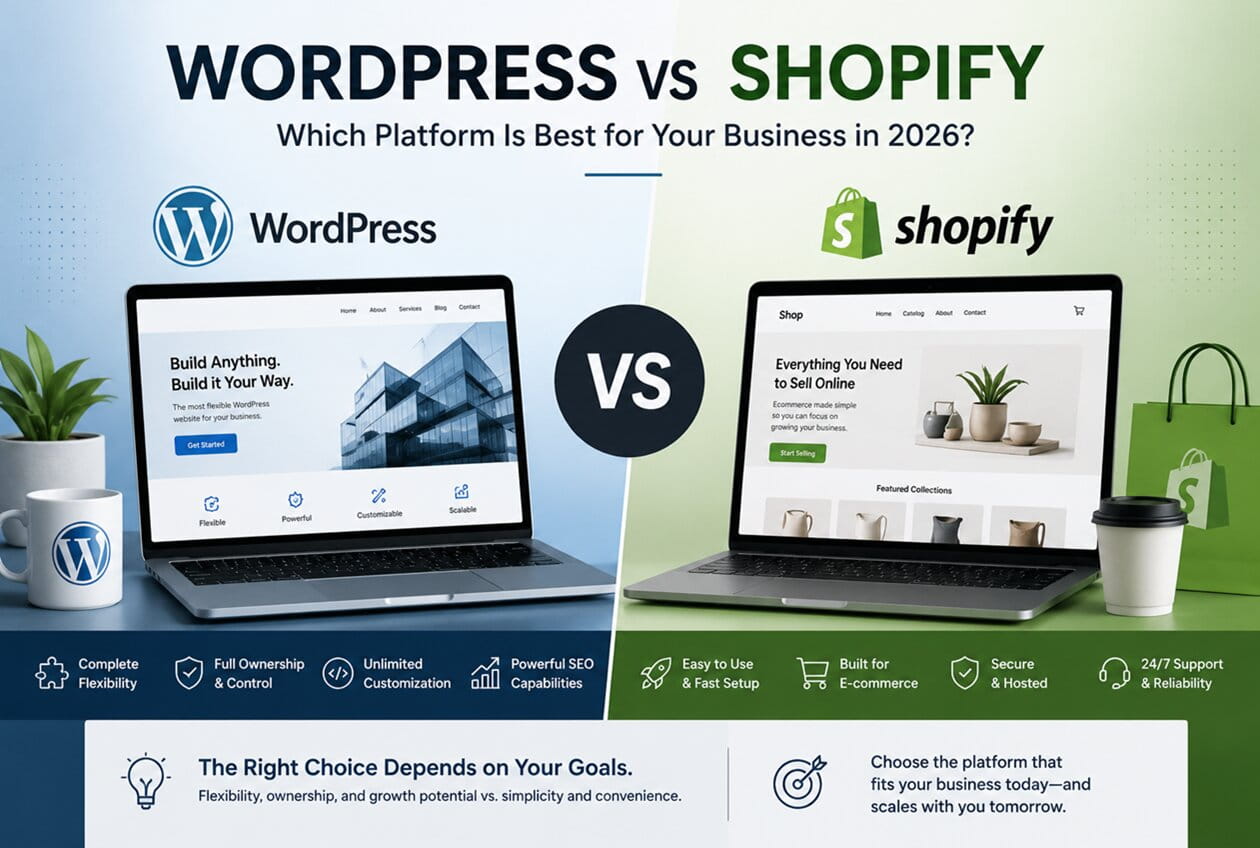
In this guide, we’ll compare WordPress and Shopify across the areas that matter most: flexibility, performance, SEO, scalability, ownership, and long-term growth.
Understanding the Core Difference
Before comparing features, it’s important to understand the fundamental distinction between the two platforms.
WordPress
WordPress is an open-source content management system that gives you complete control over your website.
With WordPress, you own:
- Your website files
- Your database
- Your hosting environment
- Your custom functionality
Combined with WooCommerce, WordPress can power everything from small business websites to large-scale e-commerce operations.
Shopify
Shopify is a hosted e-commerce platform.
It provides:
- Hosting
- Security
- Software updates
- Store management tools
In exchange, Shopify controls the underlying infrastructure and ecosystem.
For many businesses, this simplicity is attractive. However, it comes with certain limitations.
Ease of Use
Shopify Wins for Simplicity
Shopify is designed to get businesses online quickly.
Most users can:
- Add products
- Configure payments
- Customize a theme
- Start selling
without touching code.
This makes Shopify attractive for beginners and businesses that want a fully managed solution.
WordPress Requires More Flexibility
WordPress has a steeper learning curve.
You must manage:
- Hosting
- Updates
- Plugins
- Security
However, the tradeoff is complete flexibility and customization.
For businesses planning long-term growth, this flexibility often becomes a major advantage.
Design & Customization
WordPress Wins
This is one of the biggest differences between the platforms.
With WordPress, you can build virtually anything:
- Corporate websites
- Membership platforms
- Booking systems
- Learning management systems
- Client portals
- Custom e-commerce experiences
You are not limited by the platform’s built-in capabilities.
Shopify Has More Restrictions
Shopify themes are polished and user-friendly, but customization often requires working within Shopify’s ecosystem.
Advanced functionality may require:
- Premium apps
- Third-party subscriptions
- Custom Shopify development
As your store grows, these limitations can become more noticeable.
SEO Capabilities
WordPress Leads for SEO
WordPress remains one of the strongest platforms for search engine optimization.
Advantages include:
- Full control over URLs
- Advanced SEO plugins
- Custom schema implementation
- Complete content flexibility
- Better blog management
Businesses investing heavily in content marketing often prefer WordPress because of its SEO flexibility.
Shopify SEO Is Good, But Less Flexible
Shopify handles many SEO fundamentals well.
However, some areas offer less control compared to WordPress, including:
- URL structures
- Advanced technical SEO customizations
- Content architecture flexibility
For many stores this isn’t a major issue, but businesses pursuing aggressive SEO growth may find WordPress more adaptable.
E-Commerce Functionality
Shopify Excels Out of the Box
Shopify was built specifically for online stores.
Features include:
- Product management
- Inventory tracking
- Payment processing
- Order management
- Shipping integrations
All available immediately.
For straightforward online stores, Shopify delivers an excellent experience.
WooCommerce Offers Unlimited Flexibility
WooCommerce can achieve virtually anything Shopify can—and often much more.
Examples include:
- Custom checkout flows
- Complex pricing structures
- Advanced product configurations
- Membership systems
- Subscription models
- Specialized business workflows
The tradeoff is that these solutions require proper development and configuration.
Performance & Speed
Many people assume Shopify is automatically faster.
The reality is more nuanced.
Shopify
Performance is generally consistent because Shopify controls the infrastructure.
This reduces the likelihood of major hosting mistakes.
WordPress
Performance depends heavily on:
- Hosting quality
- Theme architecture
- Plugin management
- Optimization practices
A properly optimized WordPress website can be exceptionally fast and achieve excellent Core Web Vitals scores.
Poorly built WordPress websites, however, often suffer from performance issues.
Ownership & Long-Term Control
This is where many businesses overlook an important factor.
With Shopify
You rent access to the platform.
While your products and content remain yours, your business operates within Shopify’s ecosystem and policies.
With WordPress
You own the entire platform.
You control:
- Hosting
- Data
- Functionality
- Integrations
- Future development
For businesses that value independence and long-term flexibility, this ownership can be extremely valuable.
Cost Comparison
Shopify Costs
Typical expenses include:
- Monthly subscriptions
- Premium themes
- App subscriptions
- Transaction fees (depending on setup)
Costs often increase as additional functionality is required.
WordPress Costs
Typical expenses include:
- Hosting
- Premium plugins
- Development costs
- Maintenance
While initial setup can sometimes cost more, businesses often benefit from greater flexibility and lower long-term platform restrictions.
Which Platform Should You Choose?
Choose Shopify If:
- You want the simplest possible setup
- You need to launch quickly
- You prefer a managed environment
- Your store requirements are relatively straightforward
Choose WordPress & WooCommerce If:
- You need maximum flexibility
- SEO is a major growth channel
- You want full ownership and control
- You anticipate future customization needs
- Your business relies on unique functionality
Final
There is no universal winner.
The right choice depends on your business goals, technical requirements, growth plans, and marketing strategy.
Shopify offers simplicity and convenience.
WordPress offers flexibility, ownership, and unlimited customization.
For businesses planning long-term growth and investing heavily in SEO, content marketing, and custom functionality, WordPress and WooCommerce often provide the strongest foundation.
Ready to Build the Right Platform for Your Business?
Whether you’re considering WordPress, WooCommerce, Shopify, or a complete website redesign, choosing the right architecture from the start can save significant time and money as your business grows.
Explore my services or get in touch to discuss your project requirements.