
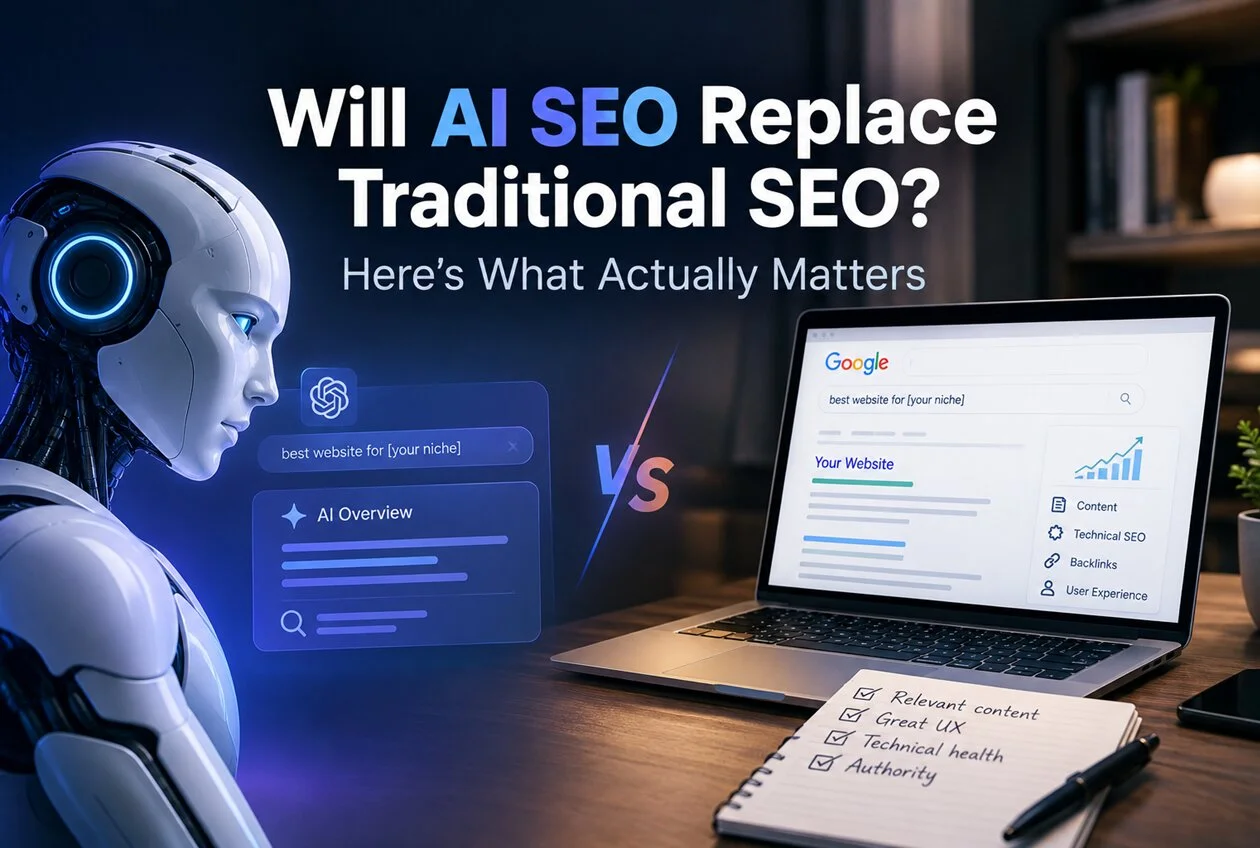
Every few months, a headline declares that SEO is dead, replaced by AI or AI SEO, chatbots, or whatever the newest search feature is. It happened with voice search. It happened with featured snippets. Now it’s happening with AI Overviews and AI chat tools. The pattern is consistent: the headline is wrong, but something real is changing underneath it, and that’s worth actually understanding.
The Claim vs. What’s Actually True
The “SEO is dead” claim usually rests on one observation: AI tools can now answer questions directly, so fewer people need to click through search results. That part is true for some searches. The leap to “therefore SEO doesn’t matter” is where the claim falls apart.
Here’s why: AI tools whether it’s Google’s AI Overviews, ChatGPT with browsing, or Perplexity don’t generate answers from nothing. They pull from indexed, crawled content on the web. The content still has to exist, still has to be found, and still has to be judged trustworthy enough to cite. That entire pipeline is SEO. What’s changed is the destination of the traffic, not the underlying mechanics of getting found.
A Worked Example
Compare two searches: “what is technical SEO” and “technical SEO audit for my business Tirana.”
The first is a definitional question. An AI system can fully answer it in a paragraph, and increasingly does — so a generic “what is technical SEO” blog post is competing for citation, not clicks, and even a citation may not translate into a visit.
The second is a request wrapped in local, commercial intent. No AI summary tells someone what’s actually wrong with their specific site, because it doesn’t have access to it. That search still needs to land on a real business’s real website, with a real way to make contact. This is the same commercial-vs-informational split that shows up across most “AI will replace X” claims — and it’s why service businesses are generally less exposed than pure content publishers.
What’s Actually Changing (Real Shifts, Not Hype)
- Zero-click searches are increasing for informational queries. This has been a multi-year trend, not something that started with AI Overviews — featured snippets and knowledge panels were already doing this. AI just accelerates it.
- Citation is becoming a visibility channel of its own. Being the source an AI system pulls from and names is a new form of exposure, even without a click, similar to how brand mentions have always mattered even without a backlink.
- Content quality bar is rising, not falling. AI systems are explicitly designed to prefer well-structured, clearly sourced, trustworthy content when selecting what to cite. Thin, templated content has less of a chance of being the source picked, not more.
- The “how” of ranking is shifting slightly. Direct-answer formatting, clear headers, and structured data now do double duty — helping both traditional rankings and AI citation — rather than being two separate skill sets.
What Isn’t Changing
- Technical SEO fundamentals — site speed, mobile usability, crawlability, secure hosting — remain exactly as important, since none of this is unique to traditional search results; AI systems rely on the same crawled index.
- E-E-A-T signals — real author expertise, genuine case studies, trust indicators — are, if anything, more load-bearing now, since AI systems are explicitly trying to identify credible sources.
- Backlinks and authority — still function as trust signals for both traditional rankings and the sources AI tools are more likely to draw from.
- The need for genuinely useful content — this was always the actual requirement behind “good SEO,” and it hasn’t moved an inch.
So What Should You Actually Do?
- Stop treating “AI SEO” as a separate discipline you need to relearn from scratch. It’s an extension of fundamentals you likely already know, not a replacement for them.
- Prioritize commercial and local content over purely informational content, if you have to choose where to invest first — it’s both less exposed to AI summarization and closer to generating actual business.
- Structure existing content for direct answers — this helps regardless of whether the reader is a human or an AI system parsing your page.
- Keep investing in genuine proof of expertise — case studies, real results, specific numbers — since this is the exact material AI systems are trying to identify and traditional readers already trust.
The Real Takeaway
AI isn’t replacing SEO — it’s replacing the specific slice of SEO that was always most vulnerable: thin, generic, purely informational content competing on definitional questions. The fundamentals that actually drove results before — technical soundness, real expertise, useful and well-structured content — are the same fundamentals driving results now. The businesses treating this as a five-alarm fire to chase are mostly wasting energy that would be better spent doing the fundamentals well.
FAQ
Is SEO becoming obsolete because of AI? No. AI tools depend on the same crawled, indexed web content that traditional search does. The skills involved are the same; some of the emphasis is shifting toward structure and citability.
What is “AI SEO” and is it different from regular SEO? Not fundamentally. What’s branded as “AI SEO” or “GEO” (generative engine optimization) is mostly a restatement of existing SEO best practices — clear structure, strong E-E-A-T, direct answers — applied with AI citation in mind.
Should I stop writing blog content because of AI Overviews? No, but consider shifting the mix. Purely definitional posts (“what is X”) face more competition for clicks now. Posts tied to your specific expertise, local market, or commercial intent remain valuable.
Will backlinks still matter if AI answers most questions? Yes. Backlinks remain a core trust signal for both traditional rankings and the sources AI systems are more likely to draw from and cite.
How long before AI fully changes how people search? This has already been a gradual, multi-year shift rather than a sudden change, and it’s continuing at a similar pace — there’s no evidence of an imminent full replacement of traditional search behavior.